

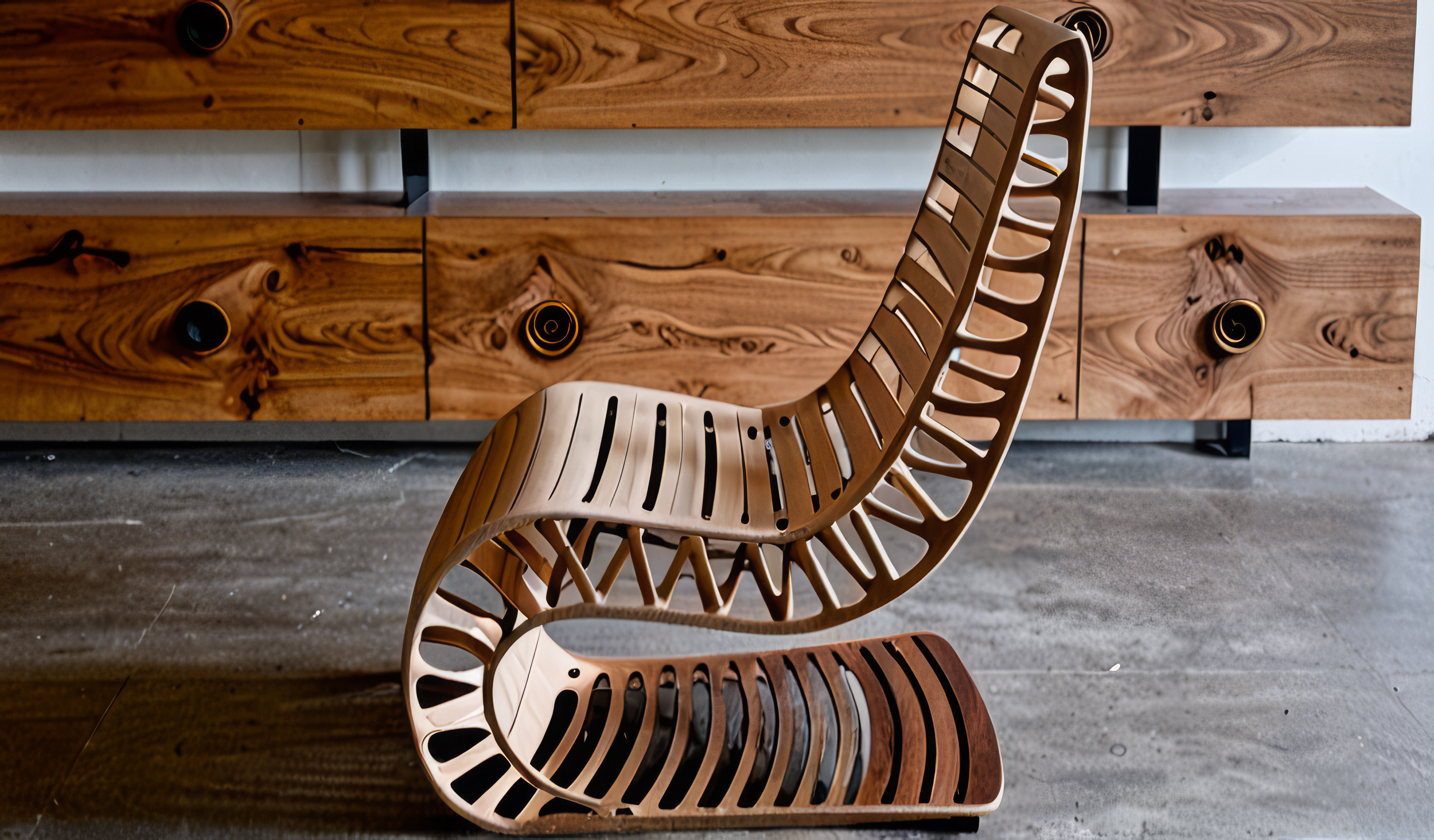
ADAPTABLE WOOD CHAIR
The concept of the “Digital Wood” demonstrator was initially conceived and developed at BioMat Studio, University of Stuttgart as part of the research into adaptive structures using renewable materials. The project was explored in-depth by student Kristína Balušíková during the Material Matter Lab seminar (WS 17/18) at BioMat, University of Stuttgart , under the supervision of Assoc.-Prof. Dr.-Ing. Arch. Hanaa Dahy.
The design investigates the live actuation of load-bearing structures by integrating adaptable material behavior and sustainable resources. Using the principle of kerf-cut wood, the demonstrator achieves flexibility through patterned cuts that create long lever arms and multiple bending zones. This flexibility enables controlled movement, actuated via electromagnets, allowing the structure to morph its shape within defined limits.
While the student version employed manual control of the actuators, future integration with embedded sensors for automated actuation was envisioned. Potential applications proposed included a form-adaptive chair and an adaptive bridge structure capable of adjusting structural capacity based on loading conditions.
Following the academic phase, BioMat GmbH further advanced the concept, refining the design for fabrication feasibility and exploring its use in custom, responsive furniture and architectural components. This included testing alternative materials, control strategies, and production methods to translate the research into practical applications, pushing the boundaries of material intelligence in sustainable architecture.