

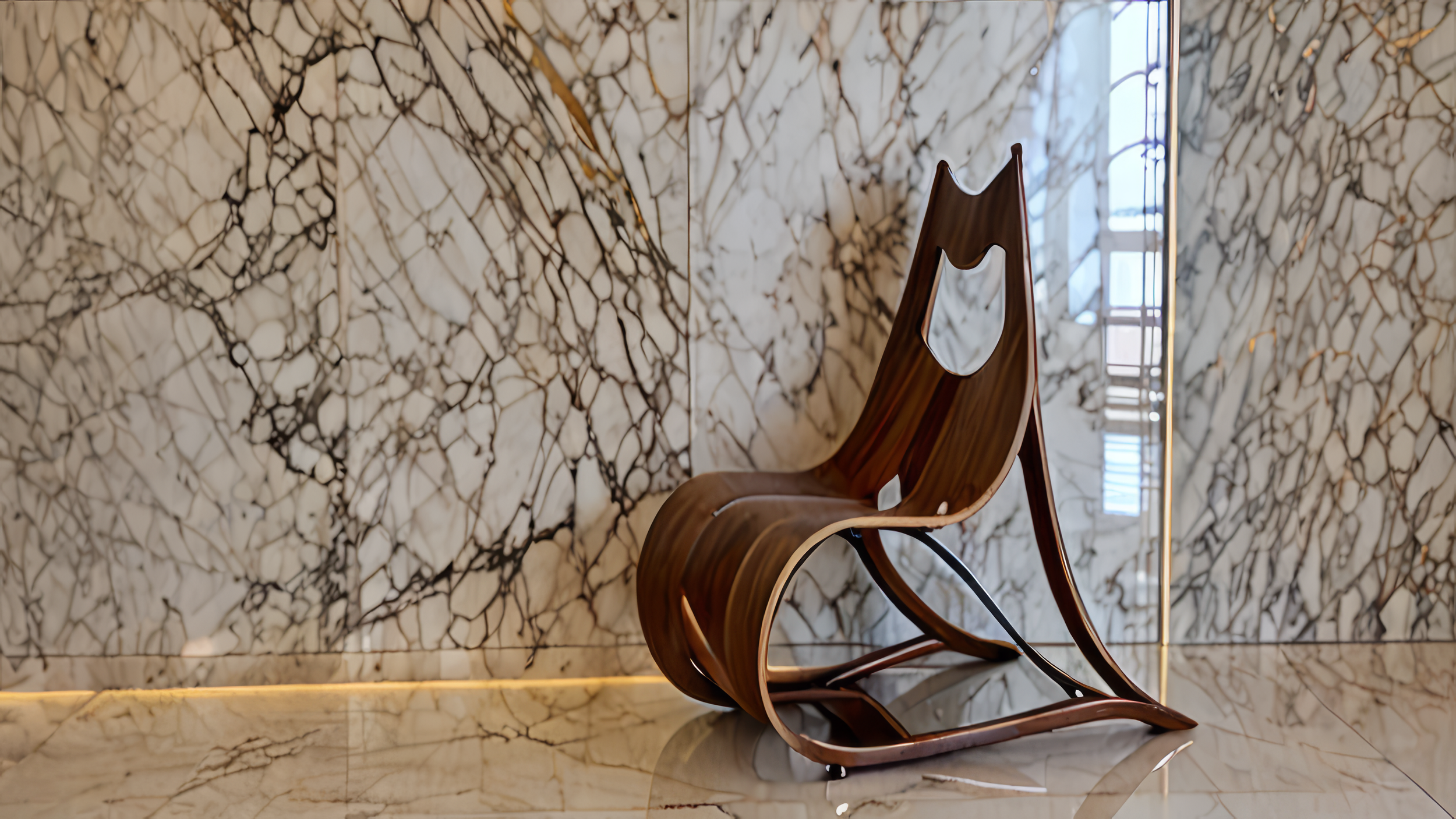
BENDING ACTIVE CHAIR
The concept of the Virella chair was initially conceived and developed at BioMat Studio, University of Stuttgart, as part of the ongoing research into lightweight, high-performance structures using renewable materials. The project was explored by students Şule Karabiyikoğlu and Nima Zahiri during the Material and Structure design studio (WS 18/19) at BioMat, under the supervision of Assoc.-Prof. Dr.-Ing. Arch. Hanaa Dahy and tutored by Jan Petrš and Piotr Baszyński.
The aim was to investigate the bending-active principle as a strategy for designing an elegant, flexible, and structurally efficient chair. The key objective was to create components that could easily bend into desired geometries while remaining strong enough to withstand applied loads. The structural system was based on anticlastic surfaces made of plywood, shaped from bending strips and doubly curved panels, reinforced by additional bending-active stiffening elements.
Initial explorations included basic FEA simulations using Grasshopper to understand the deformation behavior. However, due to the complex and nonlinear nature of bending-active systems, the design process evolved through extensive trial-and-error and rapid prototyping at 1:1 scale, allowing for iterative refinements toward an optimized form and performance.
Following the academic phase, BioMat GmbH continued the development, refining the chair for fabrication feasibility and potential real-world application. This included testing alternative materials, enhancing the structural detailing, and adapting the design for use in custom, lightweight furniture systems—contributing to BioMat’s broader mission of integrating smart material strategies into sustainable architectural design.