

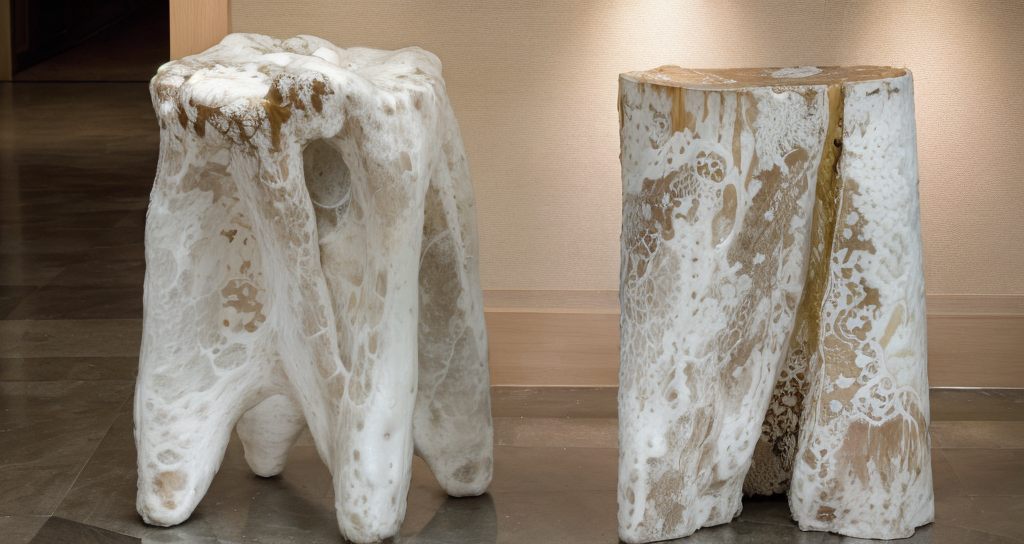
MYCELIUM COMPOSITE STOOL
This design project was initiated and conceptually developed at BioMat Studio, University of Stuttgart, exploring the structural potential of mycelium-based composites. While mycelium has been widely applied in non-structural contexts—such as insulation panels or lighting elements—its relatively low strength has limited its use in load-bearing applications. Conducted during the Material and Structure seminar (WS 2019/20) by students Francesco Milano, Karen Antorveza, Laura Kiesewetter, and Grzegorz Lochnicki, the project was tutored by Jan Petrš, Piotr Baszyński, Sophie Luz, and Evgenia Spyridonos, and supervised by Assoc.-Prof. Dr.-Ing. Arch. Hanaa Dahy.
Acknowledging the inherent mechanical limitations of pure mycelium, the research explored the creation of composite materials to enhance and adapt its structural properties. The approach integrated a permanent scaffolding system that served both as a mould during growth and as a load-bearing element in the final product. A series of material experiments informed the design process, leading to two stool prototypes: one combining mycelium with thin wood veneer, and the other pairing it with cotton fabric.
These prototypes demonstrated how mycelium, when strategically reinforced, can be shaped into functional and visually appealing furniture components. Following this student-led exploration, BioMat GmbH further considered the implications of this hybrid approach for sustainable product design, where biodegradable components and renewable reinforcements can merge to create structurally capable and environmentally responsible solutions.